

Developers
An API key, one curl and a signed webhook. Take payments on your own site and hear the moment NEAR settles them.
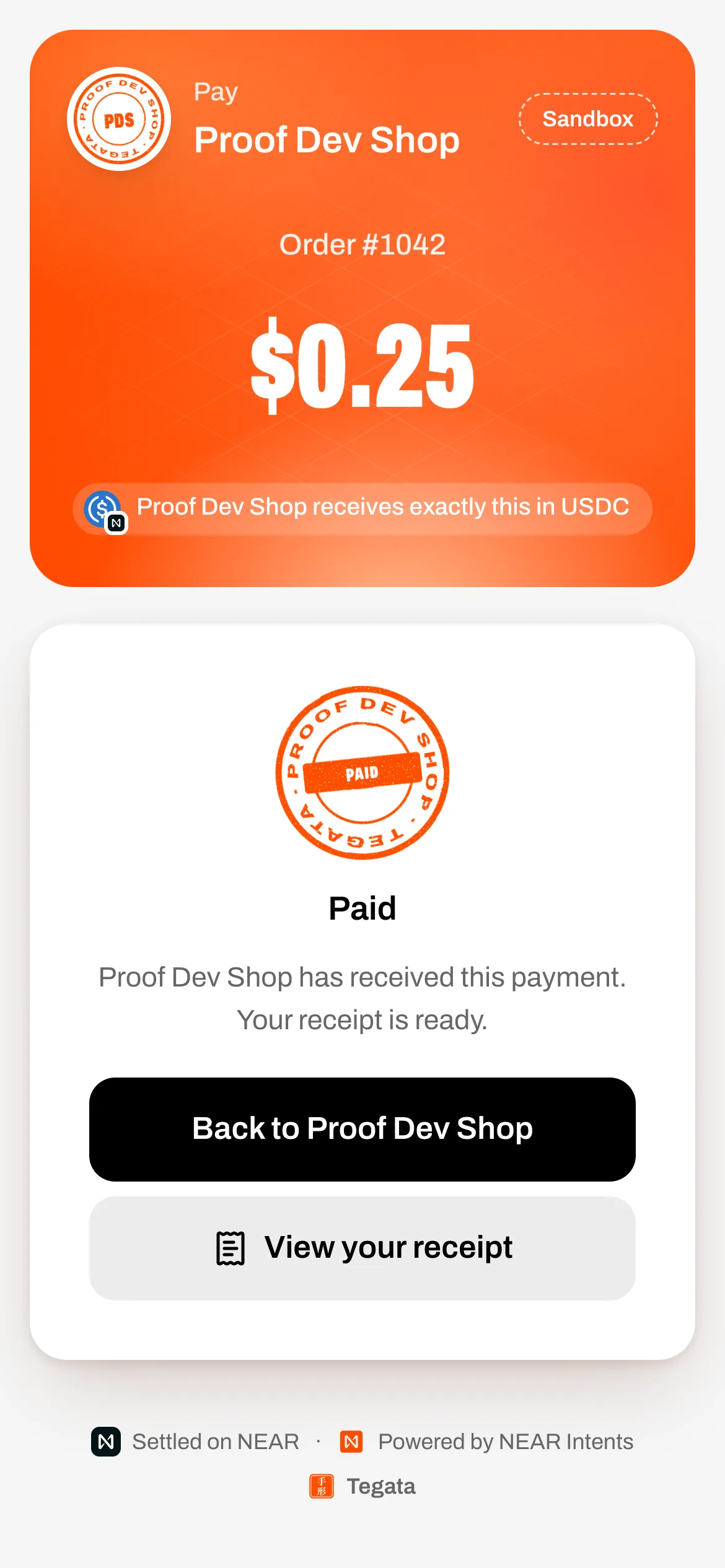
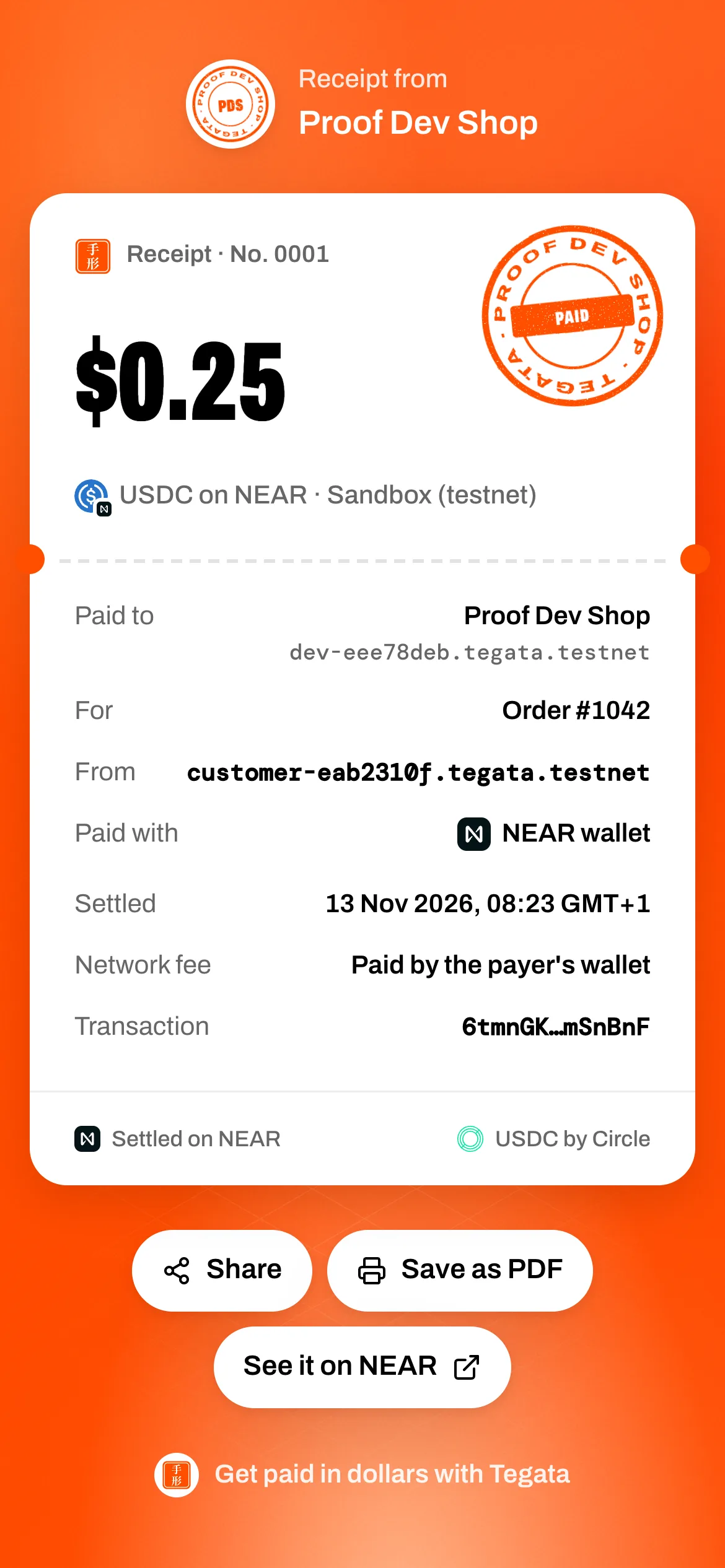
A shop's server asks Tegata for a checkout session, sends the customer to its page, and gets a signed webhook when the payment has settled on NEAR. The business receives exactly the amount, in USDC on NEAR.
Make a key. In the app, open Developers and press New key. The key is shown once; Tegata keeps only its
SHA-256 hash and shows its first characters after that. Sandbox keys start tk_test_ and work on NEAR testnet.
Add an endpoint. Type your https URL and press Add endpoint, or press Use Tegata's test inbox to see
webhooks arrive without a server of your own. Each endpoint gets its own signing secret (whsec_…), shown once and
behind Reveal secret after that.
Create a session with the curl below, and send your customer to its url.
Fulfil the order when checkout.session.completed arrives.
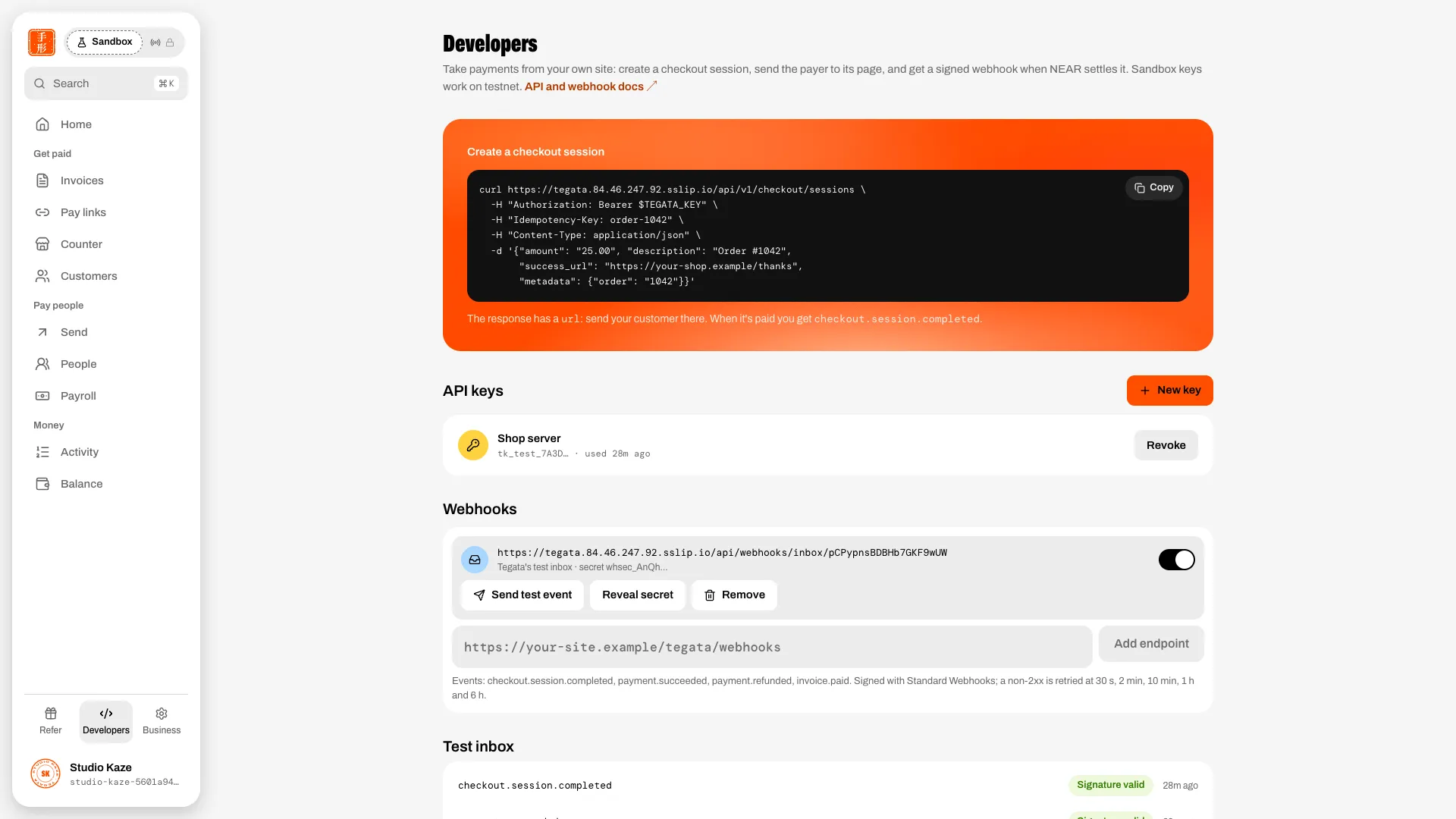
Create a checkout session
curl https://tegata.xyz/api/v1/checkout/sessions \
  -H "Authorization: Bearer $TEGATA_KEY" \
  -H "Idempotency-Key: order-1042" \
  -H "Content-Type: application/json" \
  -d '{"amount": "25.00", "description": "Order #1042",
       "success_url": "https://your-shop.example/thanks",
"metadata": {"order": "1042"}}'| Field | What it takes |
|---|---|
amount | Dollars, as "25", "25.50" or 25.5. From 0.01 to 1,000,000 |
description | What the payer sees on the page and the receipt, up to 80 characters. Optional |
success_url | An https address. Once paid, the page shows Back to your business, linking there. Optional |
metadata | Up to 20 keys, each value a string of up to 500 characters. Comes back on the session and in its webhooks. Optional |
Send an Idempotency-Key header (up to 200 characters) and a retry with the same key returns the same session
instead of a second one. The reply is 201 with the session.
A session is paid once, in full: the page takes no part-payments, and it is open until it's paid.
The session
This is the real session from the proof run below, read back after it was paid (it ran against the app on
localhost, on NEAR testnet):
{
  "id": "2f852836-9206-492e-9d6e-830148366c96",
  "object": "checkout.session",
  "status": "complete",
  "url": "http://localhost:3100/pay/E32DvMBiifrjmx",
  "amount": "0.25",
  "amount_units": "250000",
  "currency": "usd",
  "settlement": { "asset": "USDC", "network": "near-testnet", "account": "dev-eee78deb.tegata.testnet" },
  "description": "Order #1042",
  "success_url": "https://shop.example/thanks",
  "metadata": { "order": "1042" },
  "payment": {
    "id": "35fc8d8f-dabe-4c8f-9302-d37e1389b34c",
    "object": "payment",
    "amount": "0.25",
    "amount_units": "250000",
    "refunded_units": "0",
    "currency": "usd",
    "rail": "near_wallet",
    "payer": "customer-eab2310f.tegata.testnet",
    "network": "near-testnet",
    "tx_hash": "6tmnGKULQVyUUeGdpWNQYLNWCrCCmiv4iqQtsimSnBnF",
    "request_id": "2f852836-9206-492e-9d6e-830148366c96",
    "settled_at": "2026-11-13T07:23:50.807Z"
  },
  "created_at": "2026-11-13T07:23:30.520Z"
}| Field | Meaning |
|---|---|
status | open until paid, then complete |
amount_units | The same amount in USDC base units (6 decimals) |
settlement | Where the money lands: USDC, the NEAR network, the business's account |
payment | null until paid; then who paid, how (tegata for a Tegata balance, near_wallet), and the NEAR transaction |
Read it back
curl https://tegata.xyz/api/v1/checkout/sessions/<id> \
  -H "Authorization: Bearer $TEGATA_KEY"
GET /api/v1/events?limit=20 lists the latest events, newest first (up to 100), with the same bodies webhooks carry.
Errors come back as {"error": {"code": "…", "message": "…"}}:
| Status | When |
|---|---|
401 | No key, a wrong key, or a revoked one |
400 | A field that doesn't fit, such as an amount out of range or a success_url that isn't https |
404 | A session that isn't yours |
Webhooks
| Event | Sent when |
|---|---|
checkout.session.completed | A session is paid in full |
payment.succeeded | Any payment to the business settles: a session, a pay link, an invoice, a counter sale |
payment.refunded | The business refunds a payment, all or part |
invoice.paid | An invoice is paid in full |
Each event is stored once and sent to every endpoint that's switched on. The body:
{
  "id": "838bc31c-f2d2-455a-908a-cd6e84caa6f0",
  "type": "checkout.session.completed",
  "created_at": "2026-11-13T07:23:50.806Z",
  "data": { "id": "2f852836-…", "object": "checkout.session", "status": "complete", "amount": "0.25",
            "metadata": { "order": "1042" }, "payment": { "tx_hash": "6tmnGKULQVyUUeGdpWNQYLNWCrCCmiv4iqQtsimSnBnF", "…": "…" } }
}
It is signed with Standard Webhooks: the headers webhook-id,
webhook-timestamp and webhook-signature, an HMAC with your endpoint's secret. Check it with the
standardwebhooks library before you trust a body:
import { Webhook } from "standardwebhooks"

const wh = new Webhook(process.env.TEGATA_WEBHOOK_SECRET) // whsec_…
// In your handler, with the raw body as a string:
const event = wh.verify(rawBody, {
  "webhook-id": req.headers["webhook-id"],
  "webhook-timestamp": req.headers["webhook-timestamp"],
  "webhook-signature": req.headers["webhook-signature"],
})
if (event.type === "checkout.session.completed") fulfil(event.data.metadata.order)
webhook-id stays the same across retries of one delivery, so use it to ignore a repeat.
| Rule | Detail |
|---|---|
| Success | Any 2xx within 10 seconds. Redirects are not followed |
| Retries | After 30 s, 2 min, 10 min, 1 h and 6 h: six tries in all, then the delivery is marked failed |
| Endpoints | https only, and never an address inside a private network. Up to 5 per business |
| Send test event | A ping event to that endpoint only, now |
| Resend | Any delivery in the log, again |
The Deliveries log shows each event, the endpoint, the last status code and the number of tries.
The test inbox
Use Tegata's test inbox adds an endpoint that Tegata hosts. It records every webhook that arrives and checks its signature, so the Test inbox list shows each event with "Signature valid" or "Bad signature". It is the quickest way to watch the whole loop before writing a handler.
A pay button
For a fixed price with no server, point a button at a pay link:
<a href="https://tegata.xyz/pay/YOUR_LINK_TOKEN"
   style="display:inline-flex;align-items:center;gap:8px;padding:12px 20px;border-radius:14px;
          background:#FF4F00;color:#fff;font:600 16px system-ui;text-decoration:none">
  Pay with Tegata
</a>
A real one
packages/services/src/proofs/developers.ts runs the whole loop on NEAR testnet, with the app and the worker
running:
- A business gets an API key, and Tegata's test inbox as its endpoint.
- A real
curlcreates the session above. The sameIdempotency-Keysent again returns the same session. - A customer with its own NEAR account pays it the way a NEAR wallet does: 6tmnGK…mSnBnF.
- The worker reads the USDC transfer from NEAR, marks the session complete and sends
payment.succeededandcheckout.session.completed. Both arrive at the inbox with valid signatures and a200. - A second
curlreads the session back ascomplete, with the transaction hash.
The session was created at 07:23:30 and paid at 07:23:50.
Sandbox only, for now
API keys are made on the network you're on, and Live is not open yet, so every key today is a tk_test_ key on
NEAR testnet. Payers pay with a Tegata balance or a NEAR wallet; paying a session from another chain arrives with
Live.