

How money moves
How money moves
Every dollar is USDC on NEAR, every action is signed by its owner and relayed by Tegata, and every payment is checked on NEAR before it counts.
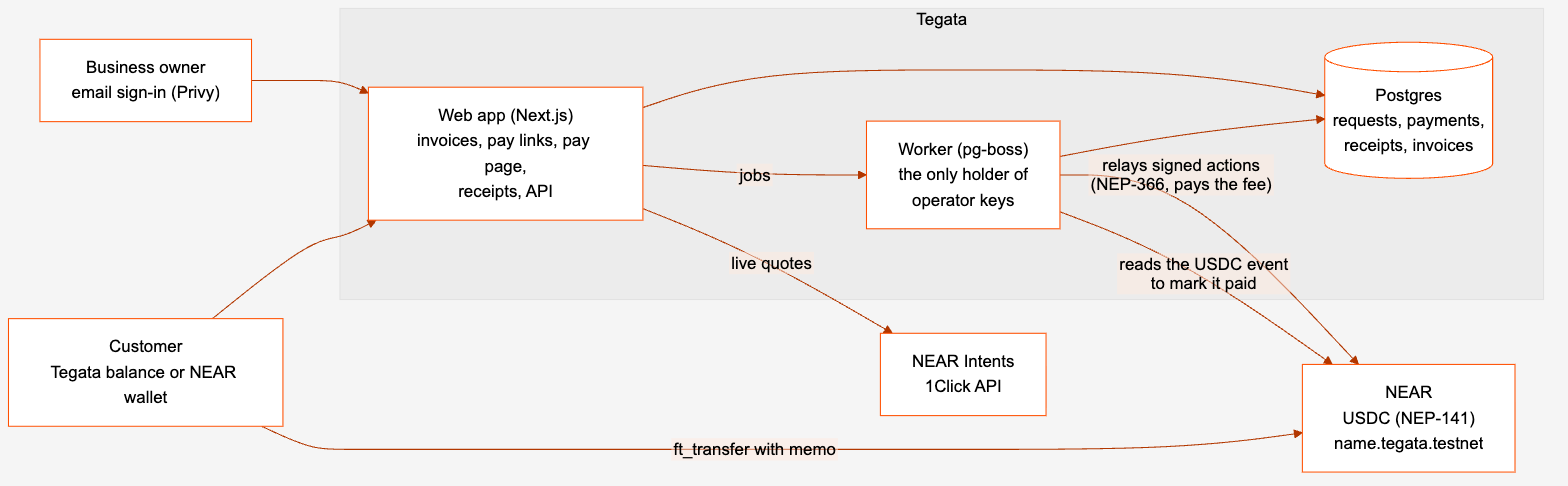
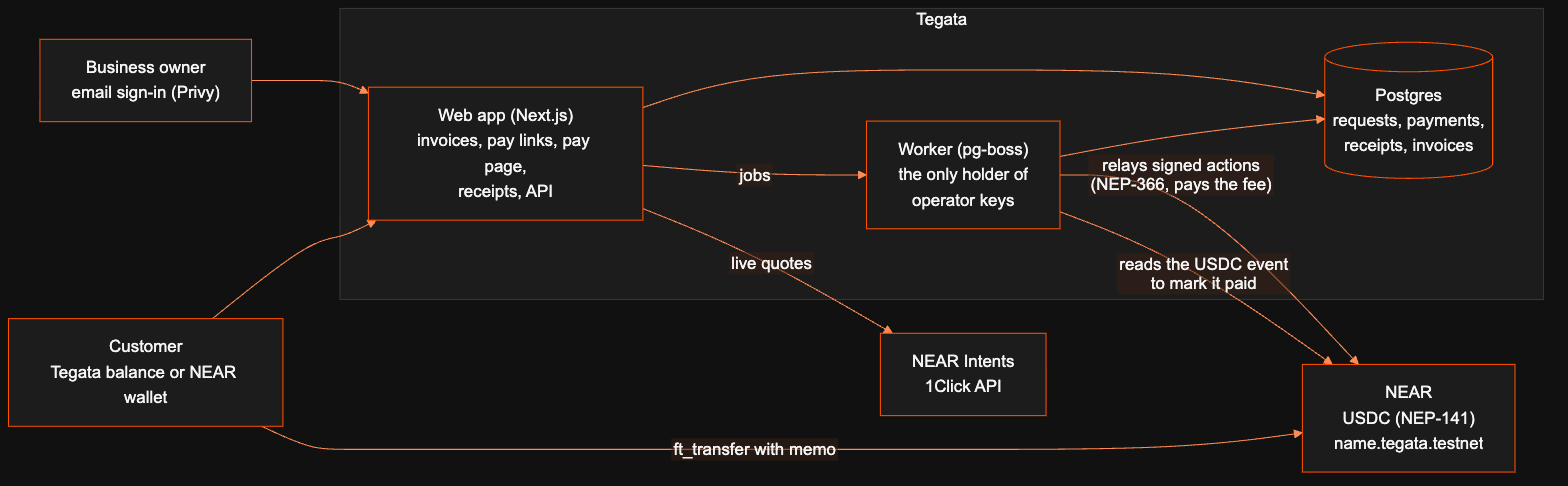
Three rules hold everything up:
- Money is USDC on NEAR. Circle's native USDC (NEP-141) holds every balance and settles every payment, send and reward.
- The owner signs; Tegata relays and pays. Each action is a NEP-366 delegate action signed by the key from the owner's email login; Tegata's worker sends it and pays the network fee. See Accounts without gas.
- NEAR decides "paid". A payment on NEAR counts only when the USDC contract's own transfer event, read from the final transaction, matches it. Money received another way can be marked paid by hand, and its receipt says so. See When is it paid?
Every movement carries a memo
| Movement | Memo on the USDC transfer | Receipt |
|---|---|---|
| A customer pays a link or an invoice | tegata:pay:<payment id> | Numbered, /r/<token> |
| Tegata pays a referral reward | tegata:referral:<referral id> | /r/reward/<id> |
| Tegata sends Sandbox test dollars | tegata:test-dollars | none (test money) |
| You send dollars | tegata:send (or tegata:<your note>) | /r/send/<id> |
| Money marked paid by hand | nothing on NEAR | Numbered, says "not on NEAR" |
A payment's life
From a NEAR wallet: awaiting → detected → succeeded or failed. From a Tegata balance: awaiting →
succeeded or failed. Only succeeded payments count toward a link or an invoice; a request is paid when they add
up to its total.